Villa HILDA | A Villa Awakens
How Lorenzo Scacchetti and Manuel Gschnell of DEAR studio meticulously guided a 1930s Merano residence into the present—without erasing its memory.

01 — The House That Gathered Time
There are houses that speak. Villa Hilda, built in Merano in 1930, is one of them. Observing the façade—its calm symmetry, the emphasized central volume, the arched windows, the balustrade-adorned terrace—one immediately senses that this was more than just a construction. It was the formulation of an ethos.
“What fascinated me from the very beginning was this compositional clarity,” explains Lorenzo Scacchetti, who oversaw the project alongside Manuel Gschnell. “The villa remains fully rooted in the tradition of classical architecture—order, proportion, prestige—yet it carries the restraint of the interwar period. Decoration is present, but understated. Not opulence, but measured elegance.”
It is precisely this balance that makes Villa Hilda such a revealing document of its era. Around 1930, Merano’s villa architecture was in a quiet state of transition: moving away from the ornamental excess of Late Historicism and the rich flourishes of Art Nouveau, toward a more functional, yet by no means austere, language. An architecture at a crossroads—a quality still legible in Villa Hilda today.
02 — Merano as the Backdrop
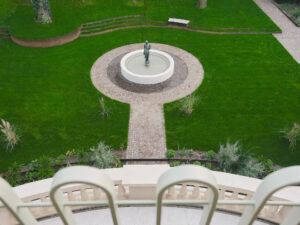
To understand Villa Hilda, one must understand Merano. For decades—from the Belle Époque well into the interwar years—the city was a world-class European spa destination, shaped by climate therapy, the culture of villeggiatura, and a bourgeois tradition of prestige in green settings. This fostered a unique building typology: not quite urban, not quite rural, but something in between—houses in the park, built for light, air, and a daily communion with the landscape.
The Merano villas of that epoch are set back from the street, surrounded by gardens, and equipped with loggias, terraces, and porticos. Their architectural language is eclectic yet disciplined. And there is always this attention to the “outside”: to the climate, the view, and the seamless connection between interior and exterior.
In this context, Villa Hilda is not an exception but a prime example. The municipal register of architectural ensembles (Tutela degli Insiemi) lists it under number 16.08 as part of a protected heritage fabric—together with its gardens, mature trees, and the overall character of the neighborhood along Grabmayr and St. Katharina streets. For what is protected here is not merely an individual building: it is a way of life within the landscape.
03 — Continuity as a Program
Unlike many of its counterparts, Villa Hilda never changed its purpose. Never a pension, never an office, never a boutique hotel—the house remained what it was from the start: a private residence. However, by 2010, it stood increasingly vacant. Its substance and technical systems no longer met the requirements of contemporary living. The villa had preserved its history, but in doing so, it had ceased to live.
“The goal was not restoration in a museological sense,” Scacchetti explains. “We wanted to reactivate the villa, not freeze it. It was meant to be inhabited again—fully livable—but without losing its character.”
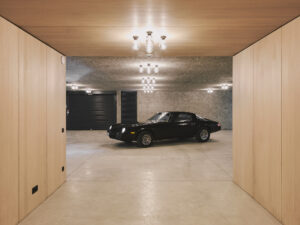
This approach sounds simpler than it is. The actual intervention often lies in the invisible: in the building services, the thermal renovation, and everything that makes a house functional without altering its appearance. Two targeted additions were made: a small wellness area with an indoor pool as a private sanctuary, and an underground garage—nearly indispensable for the daily use of a residence of this scale today.

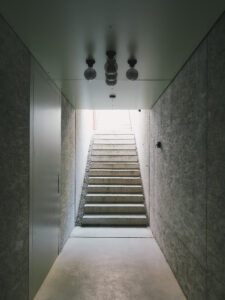
The historical spatial organization remained completely intact. The villa still receives guests just as it always has. It still distributes rooms according to the same internal logic. Only now, it is alive again.
04 — The Thread Between Eras
What ultimately turns a project like this into a design statement is the choice of materials. Terrazzo, natural wood, exposed concrete: how do these materials dialogue with a villa from 1930?


“We didn’t want to imitate the materials of the 1930s,” says Scacchetti. “Our focus was on cultural continuity—spinning a thread between the construction methods of then and now.”
Terrazzo is a quintessential example. Deeply rooted in the North Italian building tradition, it was widely used in stately residences of the early 20th century—durable, permanent, and capable of creating an elegant play of light. Using it today is not an act of nostalgia, but the reactivation of a structural intelligence that remains valid.
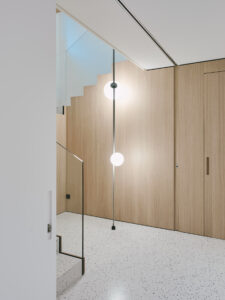

Color plays a vital role. Sage green runs through the entire project as a quiet leitmotif. “It is a color I associate very strongly with Merano’s identity,” Scacchetti notes. “Think of the Wandelhalle—one of the city’s most iconic sites. Sage green is restrained and natural; it mediates between the light plaster of the villa and the greenery of the garden. It creates continuity between architecture and landscape.”
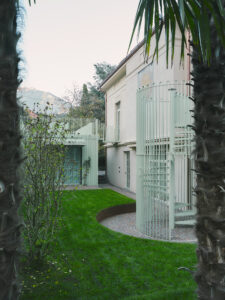
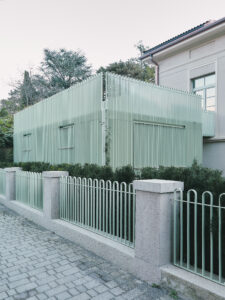

The exposed concrete, used in the ceiling and garage areas, is the most decidedly contemporary element of the intervention. Its texture comes from OSB formwork—a process that gives the concrete a warm, tactile grain, bringing it closer to the language of wood. “Concrete does not have to be hidden,” Scacchetti asserts. “With the right treatment, it becomes an expression in itself.”
The result is a project that does not distinguish between old and new, but between the essential and the superfluous. Villa Hilda continues to tell its story. And it now belongs fully to the present once more.
Project: Villa Hilda, Merano · Studio: DEAR studio, Merano · Archtitects: Lorenzo Scacchetti, Manuel Gschnell ·Year of Construction: 1930 / Revitalization 2024

